BTS: A Lesson Between Steps
Buddhism Through Service is a continuing series dedicated to understanding Buddhism through cultural immersion, historical context, and lived experience. Written by Hana Walsh, the series may also feature guest contributors offering additional perspectives. This week, Holly provides her perspective on why she meditates.
Holly Lingenfelter, 136 YinD
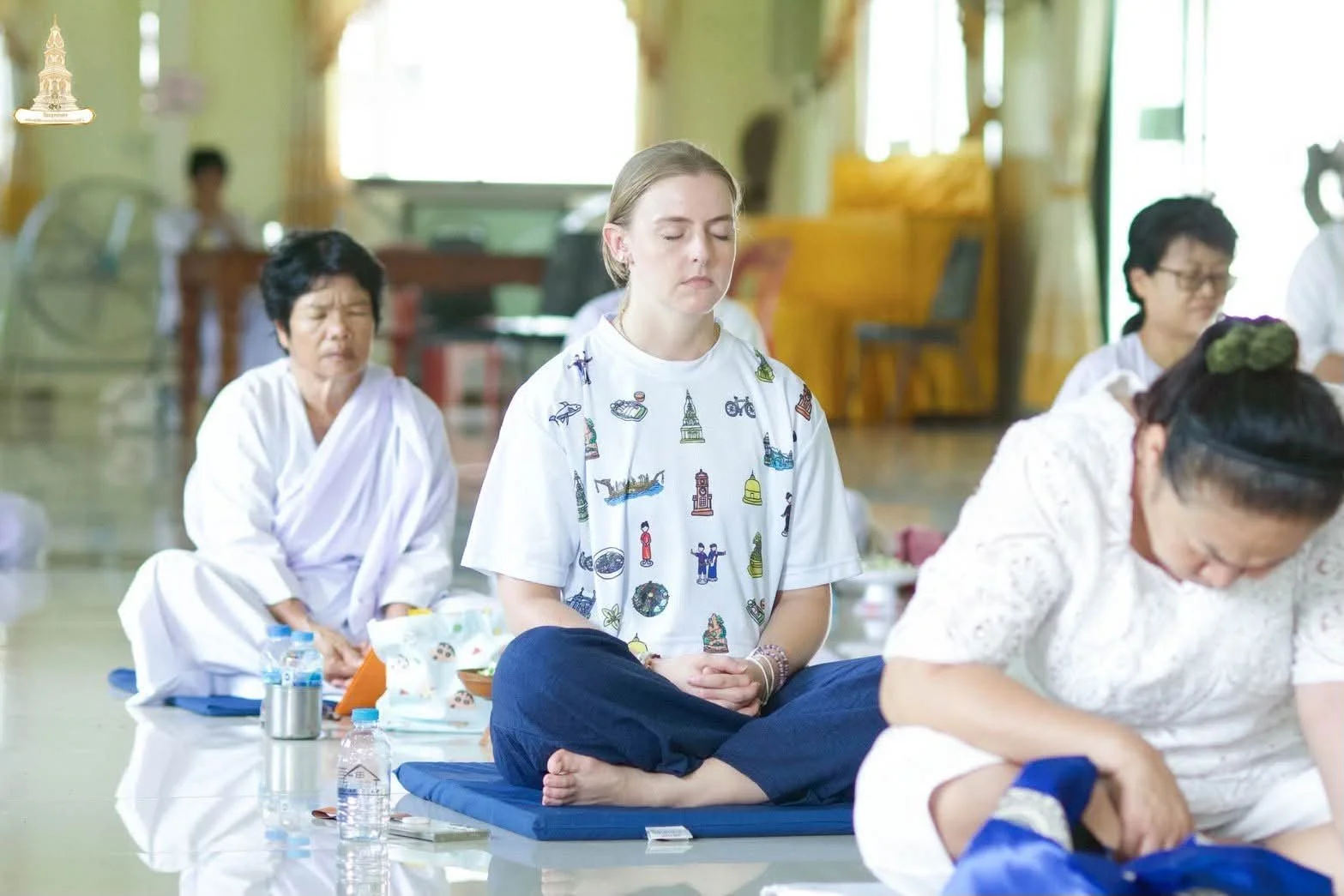
Every Sunday at my local temple, a two-hour family service is held for the public. I like to join when I can and practice meditation. Those who gather consist mainly of elders from the community —some of whom drag their grandchildren, and my students along—and I am, of course, the only foreigner who attends. The service starts with chanting in the original Pali text, followed by walking meditation, then sitting meditation, and ending with more chanting. No translation is given in English, so I simply practice more meditation during the parts of the service I don’t understand.
Mostly, everyone is very welcoming and happy to see “Teacher Holly” join the community in their sacred practice. However, I did have one not-so-friendly encounter during a meditation service, which is quite amusing as I look back on it.
Thai people are very friendly and are quick to offer help to those around them, and it’s no different at the temple. When I was new at the temple, the elders seated around me would make sure I had what I needed for meditation, gently giving me the white cloth to cover my seat cushion when I forgot to grab one, and offering me their personal chanting books, even though I could not read the Thai script.
During the walking meditation portion, everyone stands and gathers at the edges of the big room, and walks clockwise, following the monks with a sloth-like slow pace. The room is very large, leaving plenty of space between the meditators, allowing them to walk in their own style. One time, the woman behind me kept inching closer and closer until she was stepping on my heels. Every few minutes, she would grunt, loudly sigh, and whisper Thai under her breath. Apparently, my slow walking was too slow for her. I tried my best to ignore it and kept at my pace, continuing my practice, while she continued with the grunts and steps on my heels. After a few more minutes, she had had enough, and with frustration, she grabbed her friend's arm, quickly and aggressively brushed past me with a loud grunt and what I'm sure were unkind words, of which I couldn't understand, in Thai.
The heart of Buddhism is non-attachment. The infamous Thai forest monk, Buddhadāsa Bhikkhu, encouraged people to do work with a void mind. In his book, No Religion, he writes:
“Go about your business with a mind that is unattached. Work with a mind that clings to nothing and is free from all forms of attachment.”
“The busy and agitated mind which jumps into things with attachment always becomes dark and clouded with delusion, is full of worries and fears, and becomes gloomy and insecure.”
Needless to say, something agitated that woman. It could have been me, it could have been something that happened before she arrived at the temple, or it could have been a thousand other things. I don’t know exactly what it was, but I do know it’s not for me to know or ponder about.
I won’t lie and say my initial reaction was cool and unbothered. Instead, I was shocked and irritated, thinking, “Wow, that was rude. We’re supposed to be walking slow, we’re supposed to be meditating, who is she to tell me I’m meditating wrong?” And that is when it hit me, her practice is her practice, and my practice is my practice. We all have different approaches, and there is no right or wrong way. Even when we approach meditation, we go at it with a void mind, not wanting or expecting anything from our practice. Not clinging to any feeling or emotion that arises, but allowing it to pass through like a cloud. Just simply being and breathing, and allowing whatever comes to come, and not grasping any of it. Was I going to cling to one unfriendly interaction, have it take me out of my practice, and ruin the rest of my day? Absolutely not! Instead, I took it as an invitation, or a test from Buddha himself, to reflect on my own reaction and my own practice. So I continued with my slow pace, drifting back into a state of releasing frustration and fostering more compassion.
This is why I meditate. To let go of the things that don’t matter, and to continue being a light in a world that contains so much darkness. We can never control what happens and what comes our way in life, but we have the choice to focus on the darkness and negativity that exists in the world, or focus on the light and beauty that is all around us.
I’ll leave you with two quotes from The Book of Joy: Lasting Happiness in a Changing World.
“All of a sudden a car cut across the lanes in front of us and the Archbishop had to swerve out of the way to avoid hitting the other car. ‘There are some truly amazing drivers on the road!’ the Archbishop said with exasperation and a head-shaking chuckle. I asked him what went through his head at moments like this, and he said that perhaps the driver was on his way to the hospital because his wife was giving birth, or a relative was sick. There it was. He reacted with the inevitable and uncontrollable surprise, which is one of our instinctual responses, but then instead of taking the low road of anger, he took the high road of humor, acceptance, and even compassion. And it was gone: no fuming, no lingering frustration, no raised blood pressure.”
— Dalai Lama XIV
“Discovering more joy does not, I’m sorry to say, save us from the inevitability of hardship and heartbreak. In fact, we may cry more easily, but we will laugh more easily, too. Perhaps we are just more alive. Yet as we discover more joy, we can face suffering in a way that ennobles rather than embitters. We have hardship without becoming hard. We have heartbreak without being broken.”
— Archbishop Desmond Tutu