
BTS: Buddhism, Capitalism, and Cultural Change in Thailand
Buddhism Through Service is a continuing series dedicated to understanding Buddhism through cultural immersion, historical context, and lived experience. Written by Hana Walsh, the series may also feature guest contributors offering additional perspectives.
Hana Walsh, 137 YinD
To live a pure unselfish life, one must count nothing as one's
own in the midst of abundance.
-Buddha*
The Contradiction That Prompted the Conversation
One of the more confusing realizations I’ve had since moving to Thailand is that the Buddhism I read about and the Buddhism I observe in daily life do not always seem to match.
In theory, Buddhism is centered on detachment from ego, status, possessions, and worldly desires that keep people tethered to dukkha (suffering). Qualities such as humility and compassion are treated not as optional virtues, but as necessary conditions for enlightenment. The religion, at least in its teachings, leaves very little room for vanity or social competition.
Thailand, however, is also a deeply hierarchical society, where age, occupation, and social networks often dictate how respect is distributed.
To an outsider trying to understand Buddhism through its core teachings, the contradiction is difficult to ignore: how does a society function when Buddhist philosophy and status consciousness coexist?
Rather than continue speculating on my own, I spoke with two anonymous women from my community: one Thai woman who has spent her life in Thailand, and one Thai woman who has lived in Australia for the past nineteen years. For privacy, I will refer to them as Mali and Anong.
Let’s jump into the conversation.
Hierarchy, Capitalism, and Social Change
Hana: When I think of Buddhism, I think of humility, serving others, finding enlightenment— a lot of that comes from not having attachments. But in Thai culture, a lot of people seem attached to hierarchy, high positions, and knowing people in high positions. How would you describe that difference?
Mali: It’s very conflicting. The culture accepts high positions, but Buddhism teaches us to be simple.
Hana: Do you know why this changed?
Mali: It’s because of capitalism.
Anong: People pay respect for power, money.
Mali: It did not used to be like this.
Hana: Even when you were younger?
Mali: Different.
Hana: And do you think capitalism came from—
Mali: Western. Yes, from Western. Thai people start to study abroad, Western style comes in, so it’s more about money and power.
Anong: Government policy is going towards civilization. It’s a lifestyle change. More about money, and money changes everything.
Anong: Even the [Buddhist] ceremonies always have money to give to the monks. For the temple, the community— everything— money.
Hana: And that’s a new thing, too?
Mali: I think they started to change about 40 years ago now.
Anong: Everyone thinks, oh, we are one community helping each other, but money is always related.
Mali: A lot of change. Lifestyle change.
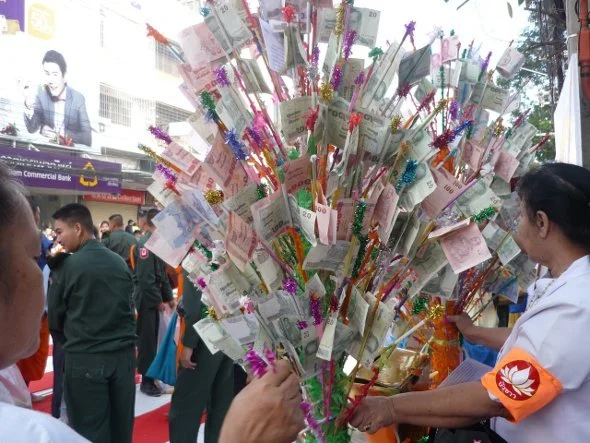
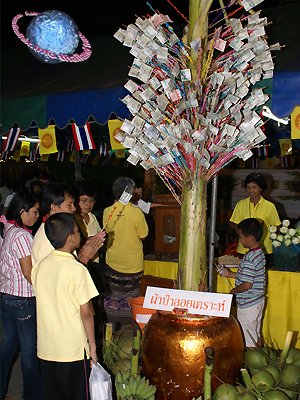
What stood out most in this section of the conversation was not simply that both women acknowledged the contradiction, but that neither treated it as abstract. They traced it to a specific social shift: the increasing centrality of money.
Capitalism is often discussed in terms of markets, development, or consumer behavior, but its more profound effect is ideological. It changes what societies reward. Once wealth, access, and upward mobility become primary markers of success, those values begin to reorganize institutions that were once governed by other principles, including religion.
The women used the phrase “lifestyle change,” which is perhaps the clearest way to describe it. This is not merely about more businesses opening or more Western goods appearing in stores. It is about the quiet normalization of ambition, image, financial power, and social ranking in places that once claimed to be spiritually indifferent to those things.
More strikingly, they described this shift as recent enough to remember.
That temporal distinction matters. It suggests that the contradiction between Buddhist teaching and Buddhist practice is not just doctrinal confusion– it may also be the product of rapid modernization.
The Monetization of Merit
Anong: Too much is in the generation of my dad and my mom. They think if you donate a lot, you will get much more back.
Mali: That’s another thing. People believe the more they donate, the more power they’ll have to get to heaven. That’s why they keep donating, donating, donating.
Hana: They’re viewing it transactionally. If I give you this, then I’ll get something in return. When really, that isn’t Buddhism.
Mali: It’s a scam.
Anong: I think it’s a trick from the monks.
Mali: They make them believe the more they donate the less karma they have, or make them get rid of the debt soon, or things like that.
Here, the conversation moved from hierarchy to something more specific: the monetization of merit.
Donation has always existed in Buddhist practice, but the issue these women identified was not the act of giving itself, but the logic attached to giving. Donations, in their view, are increasingly framed as transactional spiritual insurance: the more money you give, the more blessings or karmic relief people believe they will receive in return.
What makes this especially noteworthy is that both women were willing to describe this not as harmless custom, but as manipulation. Their language was unusually blunt: “a scam,” “a trick from the monks.” These are not the words of outsiders criticizing a religion they do not understand. These are insiders describing a perceived institutional drift from within.
That distinction became even clearer when the conversation turned to Thai temples themselves.
Institutional Buddhism vs. Ascetic Buddhism
Hana*: I met someone from Australia who told me Buddhism there is very different from Buddhism here. He said the temples in Australia were plain and simple, but the temples here are extremely ornate and colorful. He didn’t think it made sense to put so much effort into maintaining appearance when the point of Buddhism is to release attachments to material things.
Mali: I know what you mean. In Thailand, we actually have two different groups of Buddhists or monks. One is very simple, very traditional, which we call Phra Sai Pa. “Pa” means jungle. They follow a very strict, simple Buddhist way.
Mali: Then the other group is more about money, position, construction—the monks try to develop the temple in another way. Build buildings to make the temple look bigger and bigger so they can get better position. There’s positions in monkhood. Plus, get more money. So the actual Buddhist way is the simple way, but money and power make them go the other way. That is what maybe makes you confused.
Anong: If you want to find the actual Buddhist, you have to find the [Phra Sai Pa] group. There aren't many around Thailand.
Hana: I feel like most temples here are very elaborate. Big parties, offerings… and I feel like people may compare what others are able to offer.
Mali: Yeah.
Anong*: But now today there’s bad news. The monks that we think are good, they are not really good. They hide money, ladies— not only ladies. Lady boys. With drugs too.
Hana: We also have scandals like this in America.
Anong: For me, monks look like another occupation that has uniforms.
Hana: But those uniforms demand more respect.
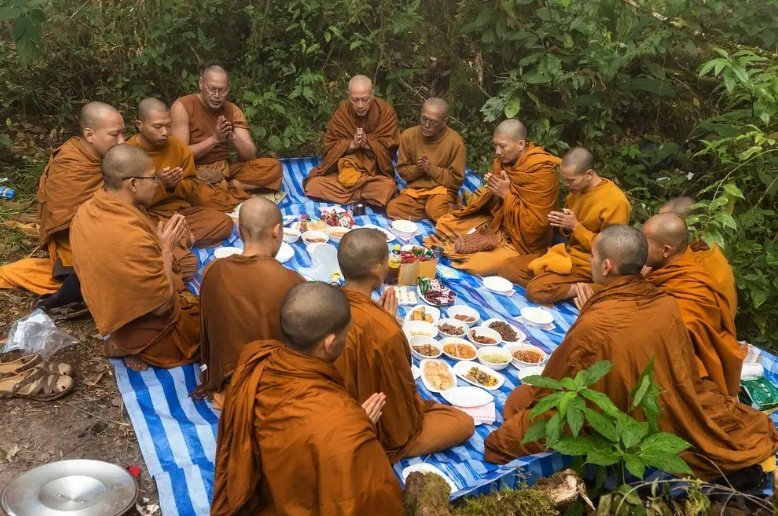
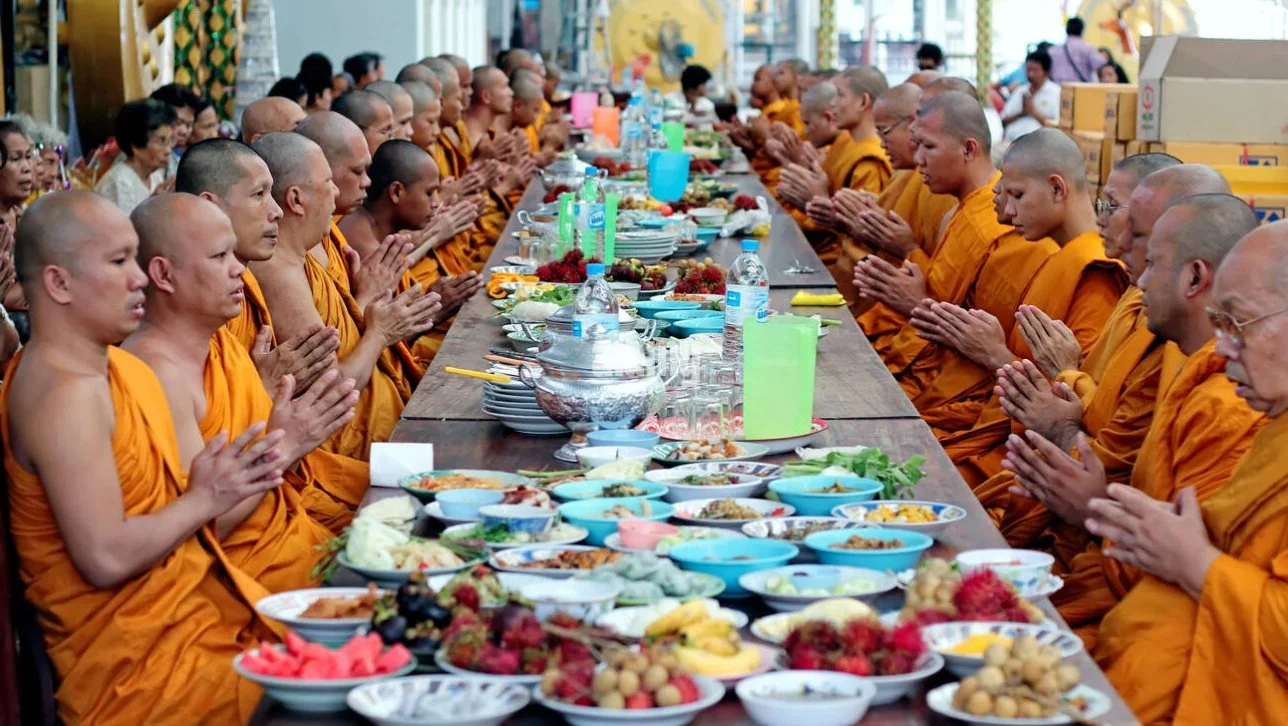
This was perhaps the most clarifying moment in the conversation, because it challenged how many people, especially foreigners, talk about “Thai Buddhism” as though it is one uniform thing.
In a previous article, I explored the major schools of Buddhism practiced around the world. What this conversation revealed, however, is that even within Thailand’s dominant Buddhist tradition (Theravāda) there appear to be two competing expressions of the faith.
They explained two visible modes of practice: one centered on simplicity, discipline, and detachment, and another shaped more heavily by temple expansion, rank within monkhood, fundraising, and social prestige.
Whether or not those categories are formally recognized in Buddhist scholarship is less important than what they reveal sociologically: even local practitioners distinguish between Buddhism as doctrine and Buddhism as institution.
That distinction helps explain why Buddhism in Thailand can feel so contradictory to outside observers. I arrived expecting to see the former and instead encountered a religious culture that, at least on the surface, felt far more ceremonial, materially elaborate, and socially layered than I had anticipated.
The women did not deny this contradiction– they confirmed what I was already suspecting. They even implied that temple authority no longer guarantees moral authority.
“Monks look like another occupation that has uniforms” is a devastating statement, because it strips monkhood of its presumed spiritual exceptionalism. The robe, in their opinion, is not proof of enlightenment.
At this point in the conversation, the central issue was no longer simply whether Buddhism in Thailand has changed. It was whether many people are still practicing Buddhism as a philosophy at all, or whether they are participating primarily in inherited ritual.
Religion, Ritual, or Philosophy?
Hana: Would you consider Buddhism a religion, or a way of living? Because when I think of a religion, I think of worshipping a God.
Mali: for me, it’s a way of living. In Buddhism, it actually teaches a way of living. The call of Buddhist is actually just a way of living. Buddha also said, don’t believe in him. Just study his lessons.
Hana: He taught people a path to enlightenment. Which is why I don’t understand why there’s so many rituals and offerings people give to the temples and Buddha.
Mali: I think it’s like, he teaches 10 kids, and then they understand a different way, and they do things a different way, and then they teach 10 kids, and they go off the path…
Hana: Like a game of telephone. Like, after teaching the lessons to new generations, it gets interpreted more wrong each time.
Mali: I think that’s what it is because people kind of lost the way. I’m pretty sure this is not the way the Buddha wants.
Anong: Especially people in the new generation, they are not interested in Buddhism. They don’t go to the temple and pay respect.
This final exchange clarified the real divide running underneath the entire conversation.
The issue is not simply that Buddhism contains corruption, or that some monks pursue money, or that temples have become elaborate. Most religions contain those things. The deeper issue is that many Thai people themselves appear to distinguish between Buddhism as a philosophical path and Buddhism as a social performance.
Mali expressed that Buddhism is supposed to be “a way of living,” not a ritual economy. In that framework, the Buddha is not a figure to be materially appeased but a teacher whose lessons are meant to reshape behavior: ego reduction, compassion, discipline, detachment, mindfulness.
Yet much of what is publicly visible in Thailand’s Buddhist culture centers on offerings, temple events, donations, merit-making, and displays of reverence that can sometimes feel more ceremonial than transformational.
I used the “game of telephone” analogy here to suggest that what we’re observing is not a complete abandonment of Buddhism, but a gradual reinterpretation over generations.
What Modernization Changes
I believe this matters beyond theology and reveals something broader about cultural change. Traditions do not usually disappear in dramatic ways. More often, they remain outwardly recognizable while the values underneath them begin to shift in response to a rapidly modernizing world.
As Western volunteers, expats, educators, and development workers, it is easy to imagine our potential influence in practical terms. We think about language exchange, business, infrastructure, education, tourism, or technology– the visible exports. Less visible are the values that may arrive with us: individual ambition, consumer aspiration, wealth as a marker of competence, status as a marker of success, productivity as a marker of worth. These values do not remain confined to the marketplace. Over time, they alter social expectations, and they can alter the institutions built on top of those expectations.
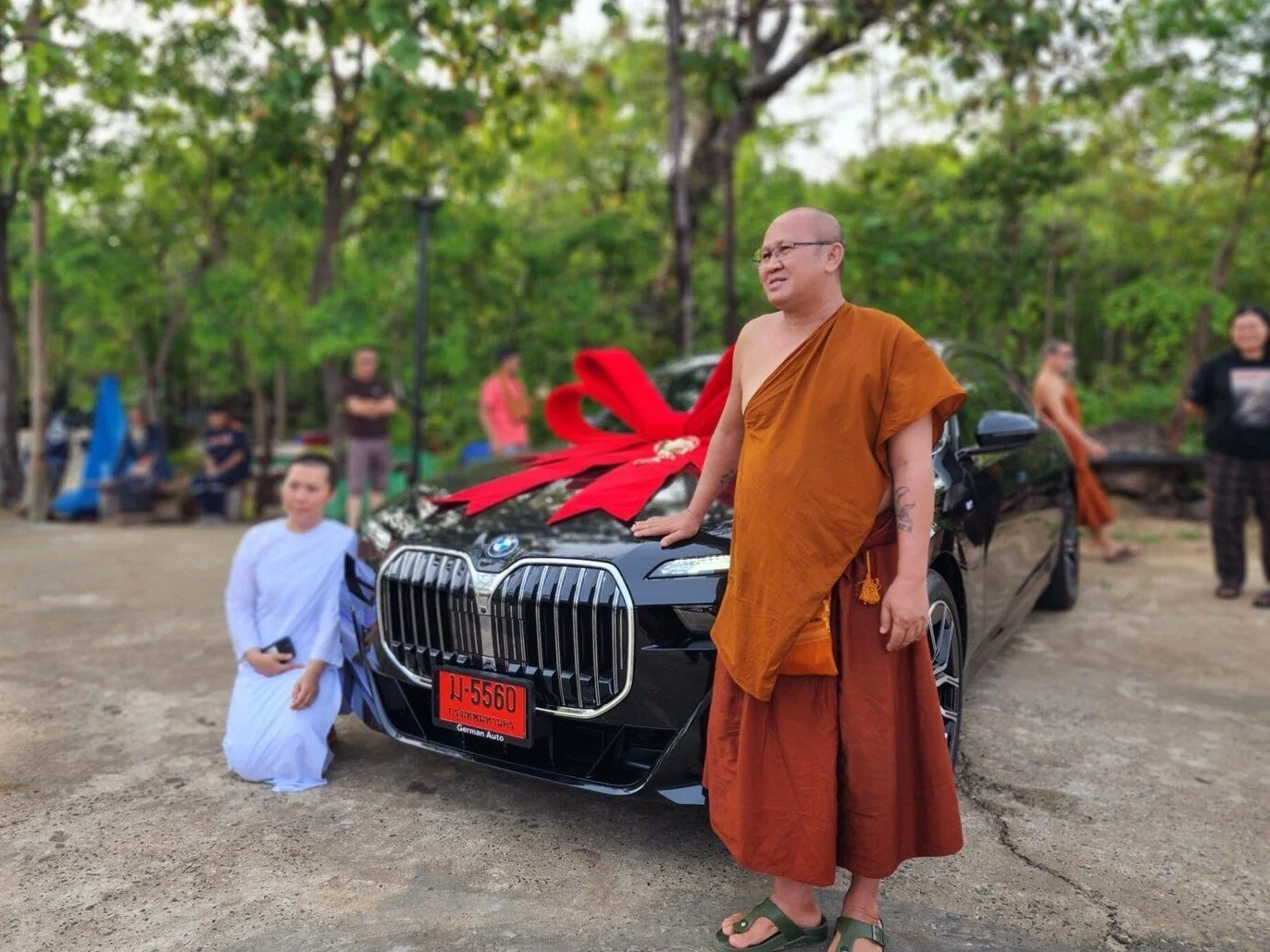
To be clear, this conversation is not proof that Western influence alone is responsible for every tension within Thai Buddhism. Religious institutions evolve internally, and corruption, hierarchy, and performative piety are not uniquely Western imports. But the conversation does suggest something worth taking seriously: modernization is never culturally neutral. When communities modernize economically, they also renegotiate what they admire, what they reward, and what they consider meaningful. Religion is not exempt from that renegotiation.
I entered this conversation hoping to better understand Buddhism, but left with a sharper awareness of how deeply cultural influence can travel. For those of us working, living, or volunteering abroad, the Western attitudes we carry with us may unintentionally outweigh the impact of the very projects that brought us there in the first place.
*Transcribed accounts with an asterisk indicate that the text was paraphrased rather than direct, to increase understanding.