
SSFF: I Miss You
i miss you (and so I am thinking about you, remembering you, and wishing to see you)
Mary Kim, 136 YinD
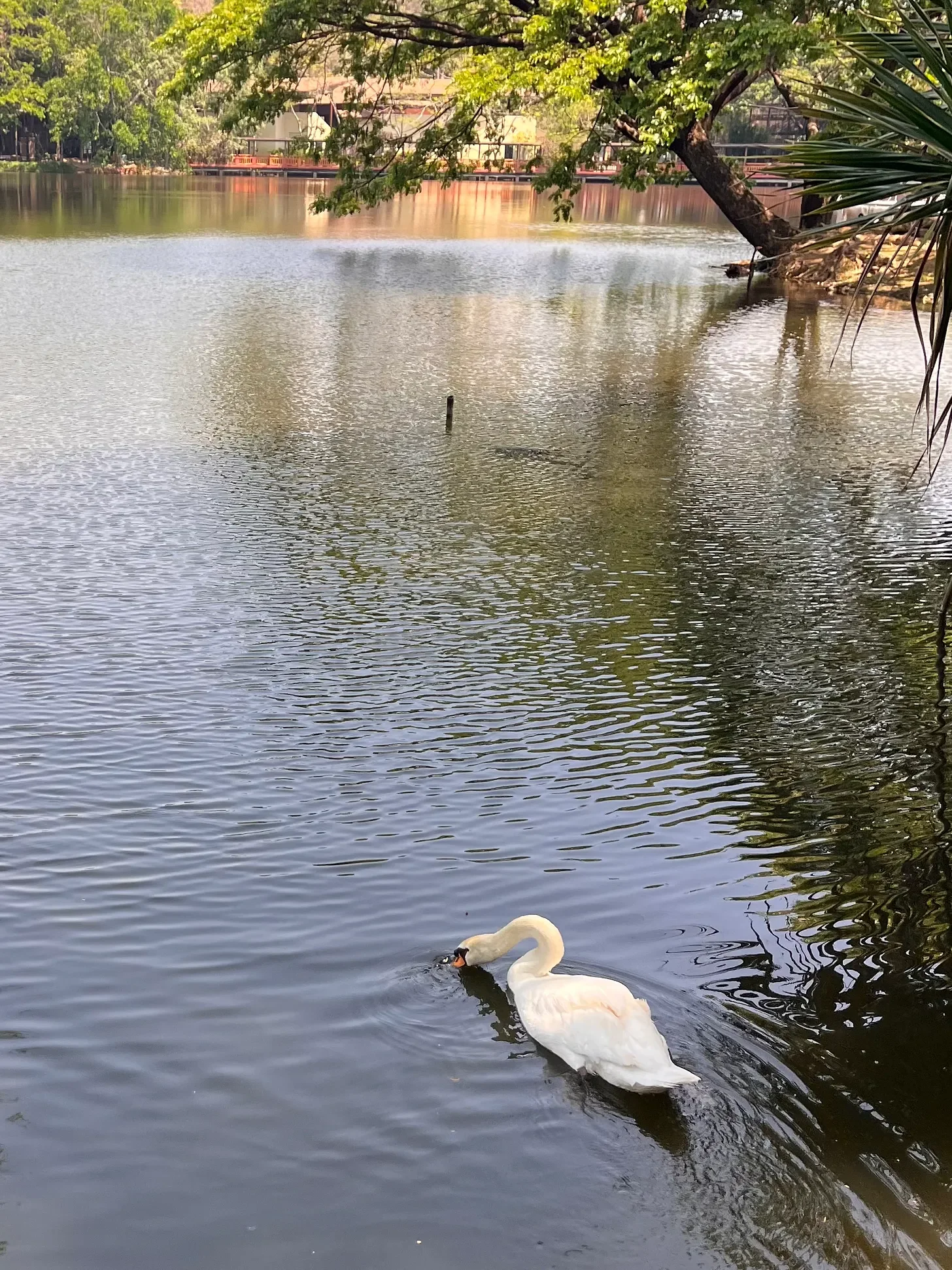
Swan in Chiang Mai
The experience of missing things — people, places, trivial things, important things — is one you get well acquainted with when you are living “in the middle of nowhere". Anyone who has moved cities or experienced any degree of change will relate, but my specific conditions of a more random location, greater distance, and extra down time make the experience feel more dramatic, I suppose. Fundamentally, however, it is the absence of said things that make you miss it. This feels obvious when you realize the homonyms of “miss/missing” don’t actually feel that different from each other. If you think about it, “I am missing a sock” and “I am missing being understood in my native language” are kind of the same thing, just on vastly different scales.
For a long time, I had been using คิดถึง kít tĕung, the Thai word for ‘missing’, without realizing it was a combination of two other words I already knew. And after thinking about it, I realized that the way this emotion is captured across languages is not the same at all, even if the experience itself is universal.
🇩🇪🇫🇷🇲🇽
The prerequisite of nonexistence for missing something is the case for many other languages too. The German version parallels English closely, ich vermisse dich. In French, tu me manques is essentially the same except the pronouns are reversed; thus, the translation becomes “you are missing to me”. The Spanish phrase has a more roundabout way of stating a similar message: te echo demenos translates to ”I throw you less”. A bit confusing. But its origins come from the Portuguese expression achar menos, meaning “to feel the need of”, which makes more sense.
🇪🇬
The intensity of this absence becomes greater in Arabic, where the colloquial way to say “I miss you” is وحشتني wahashteni. Its root word وحشة wahsha,means loneliness or desolation so the literal translation becomes “you have made me feel lonely”. On one hand, the tragedy of it seems really beautiful, but it also sounds quite accusatory which is kind of funny to think about. To me, this interpretation reads as an act of placing blame. And when you experience types of missing that are particularly devastating, or adjacent to feelings of annoyance or even anger, this honestly feels like a warranted response.
🇷🇺
On the total flip side, sometimes the absence is more passive. It can feel more like an idle waiting, like how the word скучать skuchat in Russian means both “to be bored” and “to miss”. The full phrase Я скучаю по тебе ya skoo chá yoo po ti byé means something like "I am bored along you".
🇹🇭🇹🇼🇨🇳
Then there are phrases that have to do with our thoughts, shifting the focus to be less about a physical type of distance or absence.
The Thai word คิดถึง kít tĕung for “missing” joins the verbs “think” and “to reach/arrive”, so that the literal translation for คิดถึงนะ kít tĕung ná is something along the lines of: “I am thinking of you so that, or so much that, my thoughts reach you”. The Mandarin phrase 我想你了wǒ xiǎng nǐ le also shares this thinking/missing dual meaning.
Cantonese uses a more complex version of this with the character 掛 guà which means “hang” in 我掛住你 wǒ guà zhù nǐ. The translation is “hanging on you”, but it is more that the sentiment of someone is hanging around in your thoughts.
🇻🇳
Vietnamese takes this a step further with tôi nhớ bạn. I remember the phrase from a book I read a few years ago and think the author explains it best.
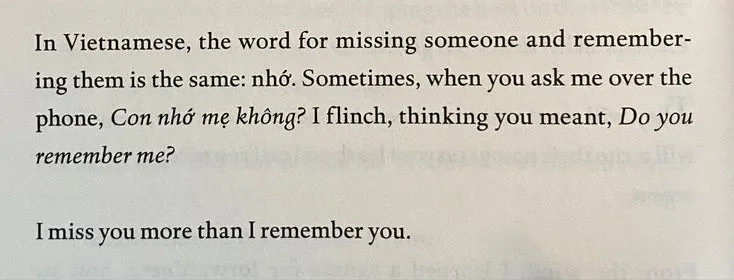
Excerpt from Ocean Vuong’s novel On Earth We're Briefly Gorgeous
🇰🇷🇯🇵
보고 싶어 bogo sipeo in Korean directly translates to “I want to see you.” Japan’s phrase for this — 会いたい aitai — is, similarly, its culture’s most common phrase for “I miss you”. I don’t know if this linguistic version is the most accurate since I have missed people and things without wanting to see them necessarily. But the concept of a longing absence shaping desire is compelling too.
🇹🇿
It is fascinating to see how many ways there are to express and understand such a commonn—at times insignificant—experience. As all the above examples show, there is no singular expression for missing someone, and Swahili has a couple of phrases that mirror these different nuances. People often use the Swanglish version of nimekumiss in casual, everyday speech because of the lack of an exact translation for the English phrase.
Although missing things often feels sad, to me, it has become a sign of a life well-lived. There will always be so many things to miss in time, as long as you experience change and life deeply. So, while it can sometimes be awful, it also feels like an immense privilege to feel the feeling of missing.
I know that even when I finish service and return home, this is something that will not change. Eventually, there will be so many things I will miss about Thailand and its lovely people I have come to know. And I look forward to missing them, too. I am even looking forward to missing the things I do not know yet.
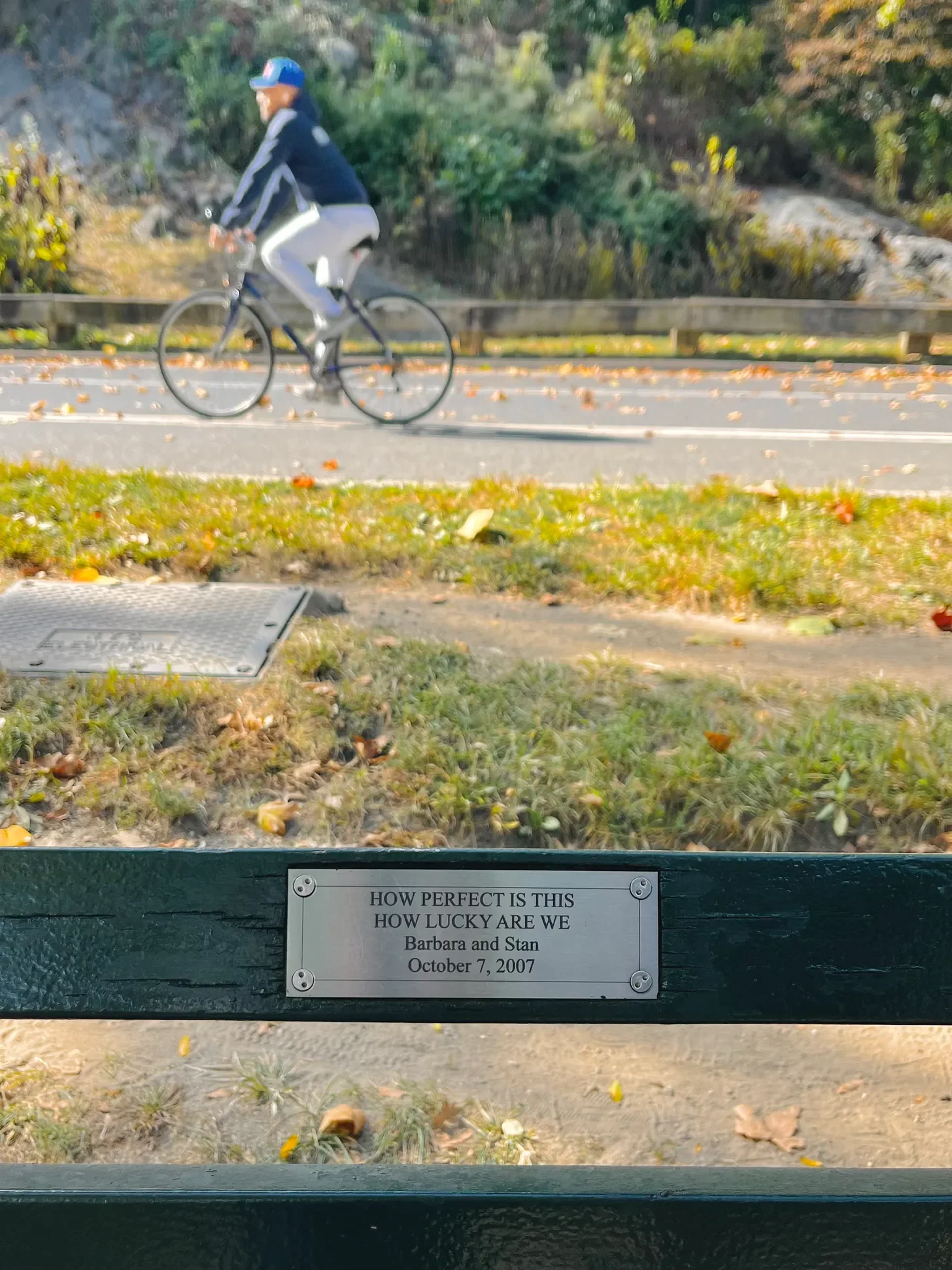
Central Park bench