BTS: It's Just a Tattoo
Buddhism Through Service is a continuing series dedicated to understanding Buddhism through cultural immersion, historical context, and lived experience. Written by Hana Walsh, the series may also feature guest contributors offering additional perspectives.
Last month, I got a sak yant.
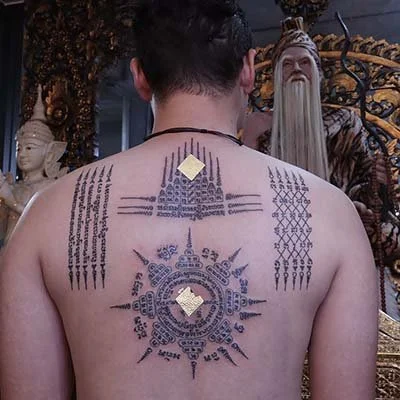
What is a Sak Yant, you may be asking? At its simplest, Sak Yant is a Southeast Asian tradition of sacred tattooing. Sak means “to tattoo,” while yant comes from yantra, referring to sacred geometric designs. The tradition is particularly associated with Thailand and Cambodia and blends Buddhist teachings with Brahman-Hindu and older animist beliefs (Weinberger, 2022).
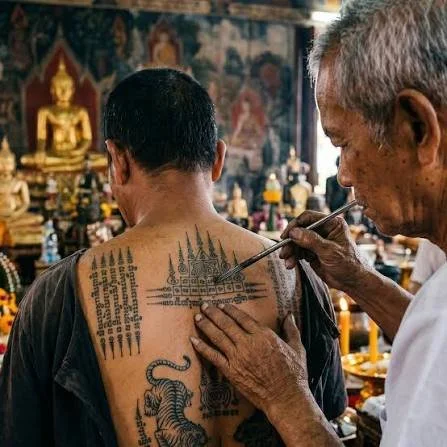
Traditionally, a Sak Yant is given by someone trained in the practice, often a Buddhist monk or a previously ordained monk known as a “Sak Yant master” or “ajarn”. Using a long metal rod, the master tattoos sacred geometric patterns, animals, figures, or lines of script into the skin before blessing the finished yant with katha, or sacred chants (Vetterli, 2024).
The tattoo is supposed to be much more than art. Different yants are associated with qualities like good fortune, charisma, success, loving-kindness, and protection from danger. The design itself is only one part of the tradition; the person giving it, the blessing performed afterward, and the conduct of the person wearing it also matter (Weinberger, 2022).
Many Sak Yant traditions therefore expect the wearer to follow certain moral rules. These vary between masters and lineages, but the Five Precepts of Buddhism commonly serve as a foundation: do not kill, steal, lie, engage in sexual misconduct, or misuse intoxicants (DRBU Staff, 2023).
This presented a slight problem for me.
If you read my first article in this series, you may remember that I wasn't exactly enthusiastic about the Five Precepts:
“The five precepts—no killing, no stealing, no sexual misconduct, no lying, no intoxication—are, on paper, entirely reasonable, so it wasn’t the content that bothered me—it was the existence of rules at all. The idea that peace or enlightenment might be conditional didn’t sit right with me. You’re saying I don’t ‘qualify’ for inner peace because I hosted wine and cheese night? Doesn’t make sense to me.”
Yeah. That was me, literally three months ago. And now here I am, getting a sacred tattoo and agreeing to take those same five precepts more seriously.
So, what changed?
I realized that even though I claim to dislike rituals and rules, I’ve unintentionally created plenty of them in my own life. I just never called them that. Ironically, one of the places where I see this most clearly is in my tattoos.
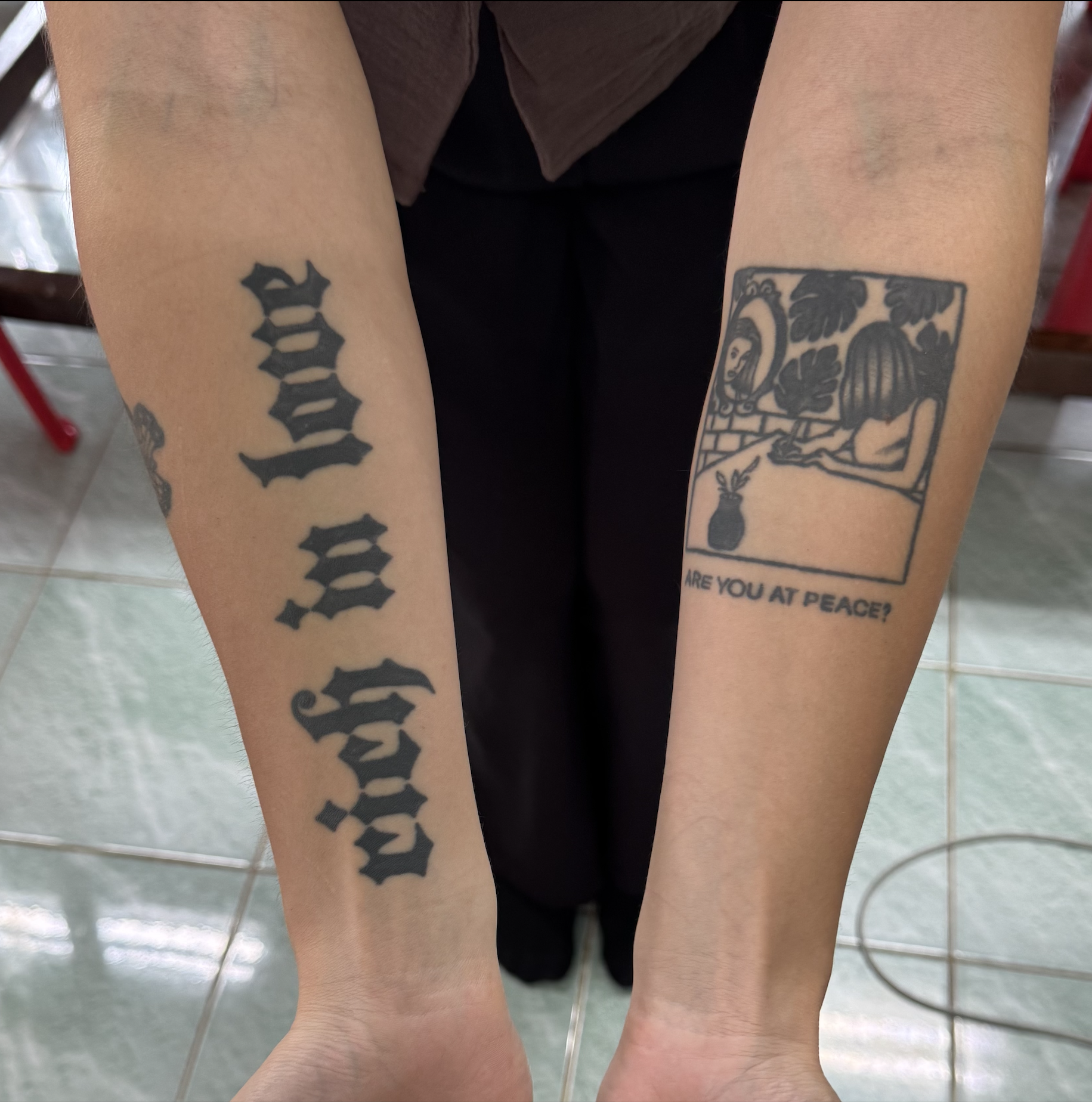
My most meaningful tattoos are intentionally placed where I can see them every day. On my right forearm, I have three large butterflies and the words “rich in love.” The phrase came from my grandma. Near the end of her life, she gave me $200. At ten years old, $200 felt like a fortune, so I asked her if she was rich. The woman, who had lived in near poverty her whole life, laughed and said, “I’m rich in love.” Now those words sit on my arm as a reminder of what I want to value.
My other arm carries the question, “Are you at peace?” It came from my dad during one of the lowest periods of my life. I was telling him how much better I was doing—how happy and productive I felt—and he listened before asking, “But are you at peace?”
He explained: Do you feel confident about your character? Do you feel at ease with your life? Are your heart and mind at rest? At the time, the answer was no. So I put the question on my arm.
My first tattoo, on my ankle, is for my mother. She was the most creative and imaginative person I’ve ever known. When I was about five, we would sit on the balcony of our apartment in San Francisco and watch airplanes cross the night sky. During the day, she called them airplanes. At night, she called them “starships.”
I still don't know whether that was a language-barrier moment since she was Korean or whether she simply thought airplanes blinking across a dark sky deserved a more beautiful name, but either way, I tattooed a starship on my ankle to remind myself to see the magic in ordinary things.
The philosophies I had already tattooed onto myself were given to me by the people I love most. The Five Precepts came from a very different source, but I began to wonder whether I could approach them in a similar way—not as restrictions standing between me and enlightenment, but as reminders about the kind of person I am trying to become.
When I thought about these tattoos together, I realized I had already been tattooing philosophies onto my body long before I ever got a Sak Yant: be rich in love, strive for inner peace, look for magic.
So I got the Sak Yant.
The ajarn chose Hah Taew, or “Five Rows,” one of the most recognizable Sak Yant designs. Its five vertical rows contain sacred syllables and incantations, commonly written in Khom script. There isn't one universal translation of Hah Taew—the formulas and interpretations vary between masters and lineages—but its rows are generally associated with different forms of protection, fortune, success, and attraction (Mianlamai, 2023). I was most drawn to the line he explained to me in relation to fate, and I asked if he could highlight it in red.
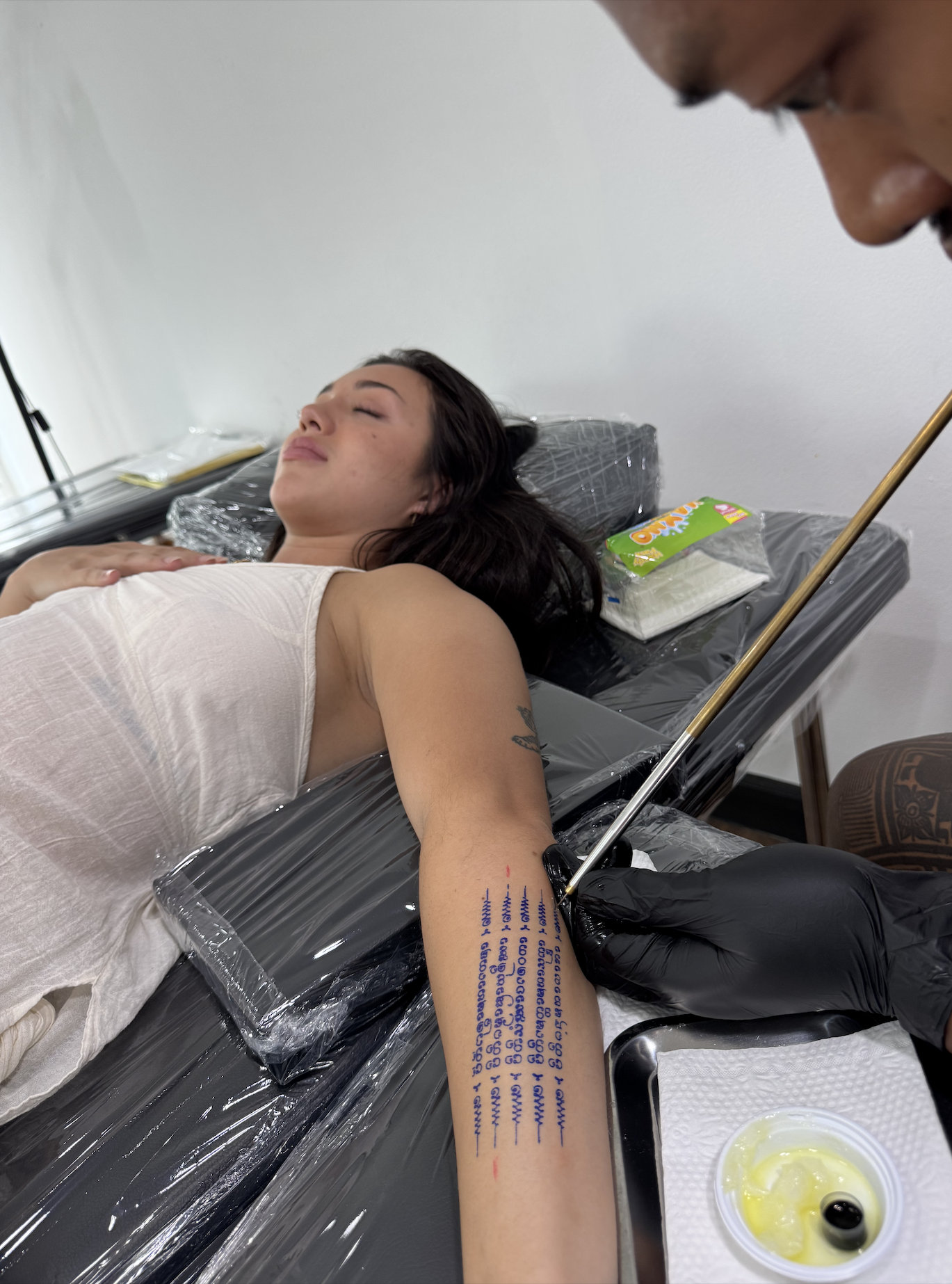
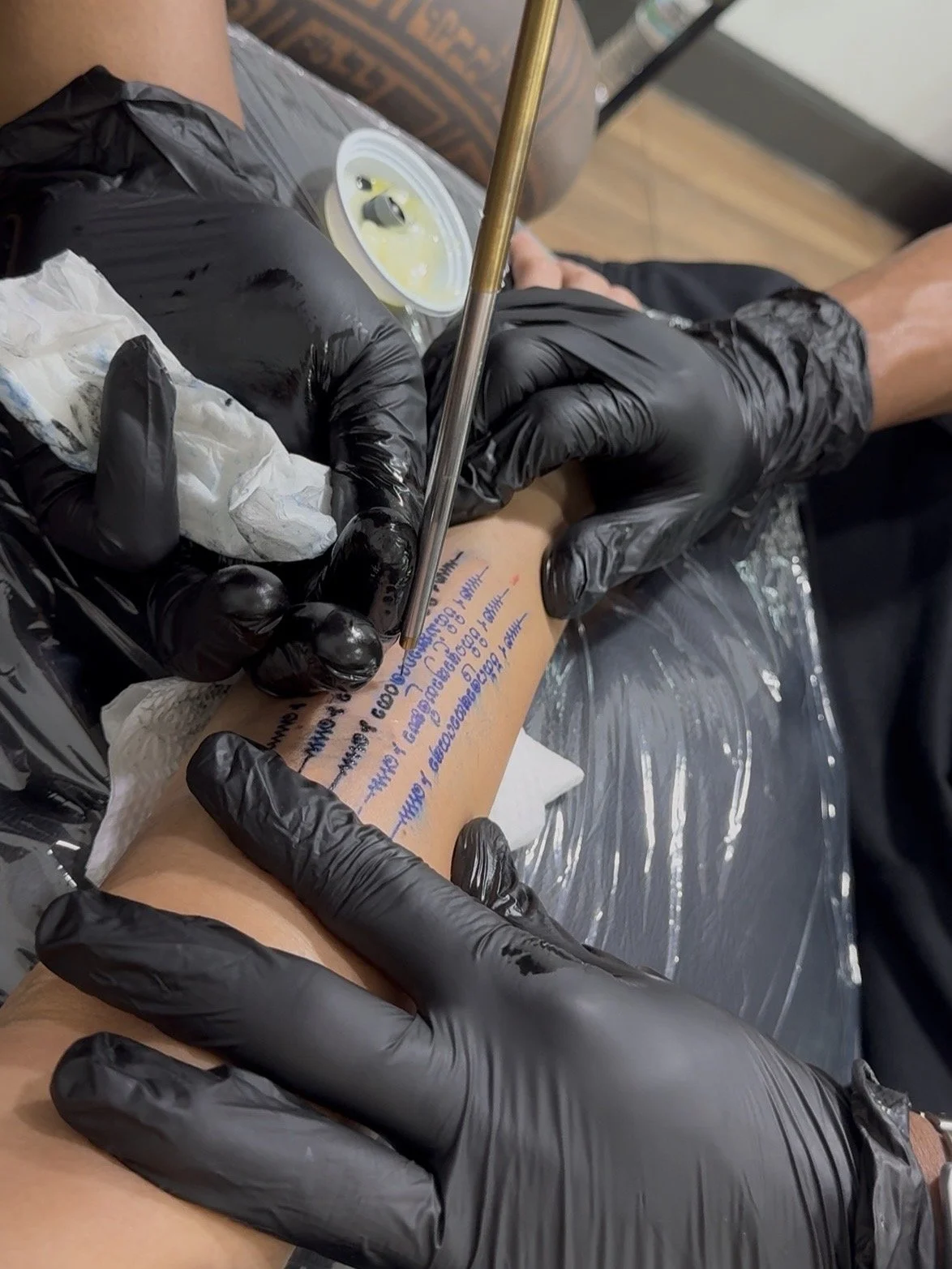
For me, fate doesn't necessarily mean believing every detail of my future has already been written. It's a reminder that I don't control everything that happens next. I can plan and work toward the life I want, but some things will unfold regardless of how carefully I try to engineer them.
Now that reminder sits permanently on my arm alongside the others.
This experience had me wondering if this is why humans have created rituals in the first place. Whether it’s a prayer, an offering, or sacred designs etched in skin, we take invisible concepts and give them physical forms.
When I first encountered Sak Yants and the Five Precepts, I saw them as rules imposed from the outside. But a Sak Yant can’t make me enlightened any more than the words “rich in love” can make me loving. All they can do is remind me of the person I’m trying to become.
Works CitedDRBU Staff. (2023, November 16). Intro to buddhism: What are the Five Buddhist precepts?. Dharma Realm Buddhist University. https://www.drbu.edu/news/intro-to-buddhism-what-are-the-five-buddhist-precepts/ Mianlamai, S. (2023, March 2). Yantra: From sacred geometry to sacred tattoos. Thailand Foundation. https://thailandfoundation.or.th/yantra-from-sacred-geometry-to-sacred-tattoos/ Vetterli, S. (2024, September). Sak Yant tattoos: Understanding the roles of monks, Ajarns, and tattoo artists. The Bamboo Rooms® - home of multiple award winning tattoo artist Keng. https://www.bambootattoo.co.uk/sak-yant-tattoos-understanding-the-roles-of-monks-ajarns-and-tattoo-artists/ Weinberger, S. (2022, October 7). Lines of power: The Mystic Tradition of Sak Yant tattoos. Kintaro Publishing. https://kintaro-publishing.com/blogs/news/lines-of-power-the-mystic-tradition-of-sak-yant-tattoos?srsltid=AfmBOoqAh53gczZA6cZFDus5kx0lyURG27ozftaC2eZ0G0i2HItinyDl