
Fluency
Introducing our limited article series, PST 137, featuring writers who just experienced three months of Pre Service Training in Don Chedi, Thailand. Grace Richardson starts us off with a piece on her language learning experience with her host mom.
Grace Richardson, 137 YinD
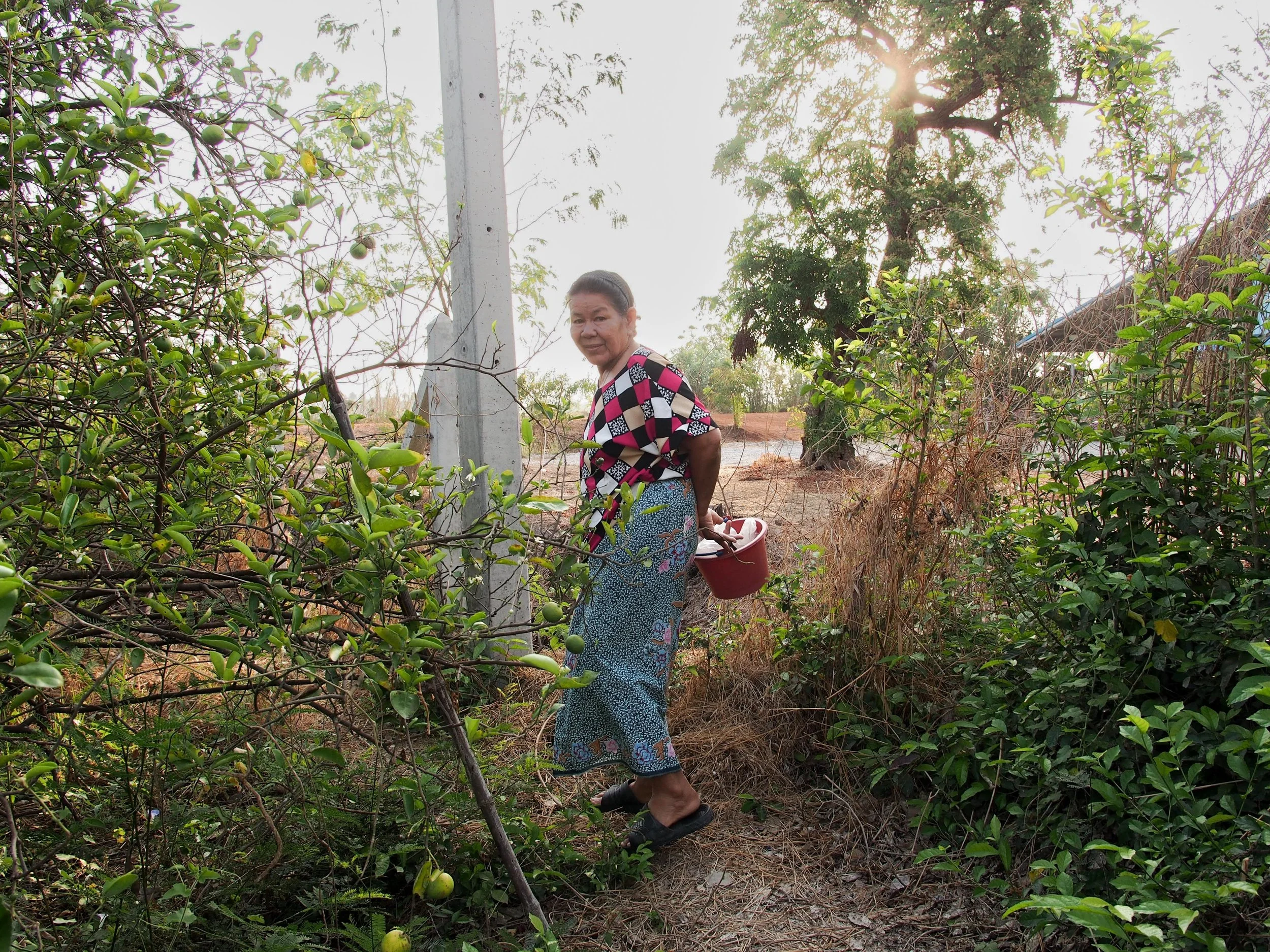
Photography by Samantha Parrish, 136 TESS
When I first arrived at my host mom’s house, without showing me around or attempting an introduction, she ushered me into my room and shut the door. It didn’t feel unkind or inhospitable, but instead like a shared understanding that this was something new for both of us.
I come from a family where there is always something going on; eight people in one house is cause for chaos. The silence felt unfamiliar to me. Neither of us was quite sure what to do next. For a while, we stayed out of each other’s way. We didn’t quite have a rhythm yet, and moving carefully around one another seemed like the safest option.
From the beginning, she seemed to think my Thai language abilities were much more advanced then they actually were. I knew fewer than five words! She spoke quickly, confidently, and at length - and my attempts to use Google Translate or hand gestures were met with confusion and a furrowed brow. On my first day of language class, due to my unsuccessful efforts to communicate my schedule the night before, she woke me up at 5 a.m. with sharp raps on my door, worried I’d be late for the 8 a.m. start time. There was a consistent, quiet, nervous energy - at least on my end - and nothing ever felt certain.
After several weeks of sidestepping and coexisting, something clicked.
I came home one day with a scraped knee from playing soccer, planning to clean it myself. My host mom noticed it immediately, concern written across her face. She led me inside by the wrist (speaking rapid Thai), grabbed the largest bottle of saline solution I’ve ever seen, and carefully tended to my cut. I was touched by her care, given the mildness of the situation, and for the first time, our relationship felt familiar.
From there, we fell into a routine that often went hand in hand with humor. She liked to call me a “boy” because I fixed a peer’s bike and the lock on my door, pointed out my “dirty” elbows and legs from lying on the ground (I was dirty “thúk wan,” according to her), and commented on the way I walked, saying it was “like a man.” It felt like being teased by family in the best way.
She also laughed at herself, frequently calling attention to her missing teeth with a cackle, or giggling as she bundled up in layers when the weather felt warm to me. We became, in a soft way, comfortable enough to be a little ridiculous around each other.
She took care of me in ways I never would have expected. When I returned home to find my bathroom and bedroom floor completely flooded, she insisted on cleaning it herself, waving off my attempts to help. There was no discussion, much to my chagrin, just action. The meals she cooked were some of the best I’ve ever eaten. The variety and flavor each day felt almost unbelievable!
Not everything became easier, though. Sometimes I tried to learn Thai from her, as we were encouraged to do in language class, and she would explain words in long, fast sentences that left me more confused than before. Somehow, she believed I understood this chaotic teaching style, and I kept trying to learn from her anyway. Near the end of PST, she asked me what “raa-dtree sà-wàt” meant in English. When I told her it meant “goodnight,” I later overheard her wandering around the house muttering, “good… night… good… night.” A few mornings later, she greeted me with “goodnight,” and it felt heartwarming, especially knowing many older Thai people feel reserved about speaking English.
There were also moments I didn’t know how to respond to.
When her dog died, I didn’t have the language to comfort her. I wasn’t sure what to say or do, so I stayed quiet in a different way than before - not out of uncertainty, but out of respect.
By the end of PST, I realized that our understanding hadn’t come from perfect communication. It came from repetition, shared space, and small acts of care that built on each other over time. My host mom is small in stature, but there is a steadiness to her. It is a kind of strength that shows up in how she cares for others, how she maintains her routines, and how she gives without making it feel like something that needs to be acknowledged.
Now I’m at my permanent site, nine hours away, and yesterday she texted me, “don’t go outside this afternoon, it’s too hot, I’m worried you will faint.” Her messages carry the same maternal care I felt from the beginning - I just recognize it more easily now.
I will always be thankful I learned to live alongside someone with whom I didn’t share much in common, at least not in the ways I expected (besides a birthday, which was a fun discovery). Still, we found a way to understand each other.