
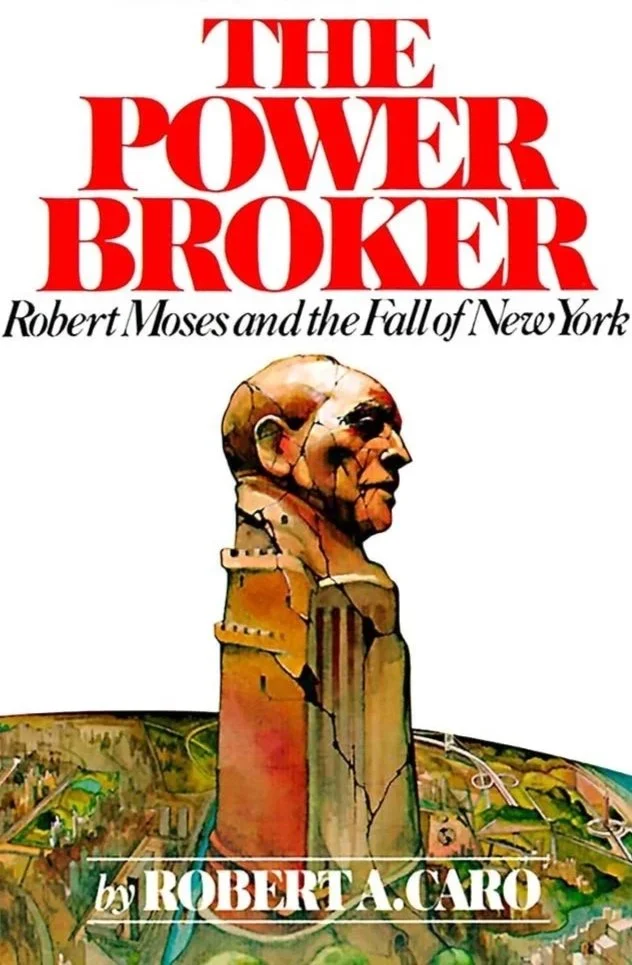
What We’re Reading: The Power Broker: Robert Moses and the Fall of New York
Welcome to the “What We’re Reading” ongoing series where you’ll find PCVs sharing their thoughts, reflections, and reviews on books of any genre. Sticky Rice Editor in Chief Gretchen Evans also interviews fellow Volunteers and they discuss the books they’ve been reading at site. Don’t forget to leave us a comment below if you’ve also read any of these books!
Noah Albanese, 136 TESS
"Democracy had not solved the problem of building large-scale urban public works, so Moses solved it by ignoring democracy."
Last week, it was announced that Los Angeles, California completed its construction of the D-line extension in its subway system. Connecting Korea Town to the West-Side, this new line will cross into the important neighborhoods in downtown Los Angeles.
It took 65 years to complete.
Building large-scale public infrastructure is a difficult task for democracies compared to autocracies. Democracy gives its citizens avenues such as the courts, elections, and protests to air out their grievances. These are great tools for locals to let their voices heard, but often pause and delay large-scale infrastructure projects. For autocracies, like China, it is quite easy to build public infrastructure because there are fewer avenues for locals to oppose its construction. Therefore, the questions become: Is America capable of rapidly building large scale infrastructure? Is there a cost for building things rapidly? This is what The Power Broker is about.
Most people have never heard of Robert Moses. This is understandable; he never held any elected position and he never garnered the spotlight. His accomplishments, however, are remarkable. Moses created 25 state parks in New York, built 13 bridges, over 1,000 miles of roads, built the U.N. Building, built the 1964-65 World Fair, and was personally responsible for urban renewal projects that created highways cutting straight through Manhattan. Dubbed “Bob the Builder,” Robert Moses was a civil servant in New York City politics that somehow gathered enough power to get all of this done. How did he do it?
Caro argues that his success stemmed from his lack of hesitation in gathering and using power. To eliminate electoral opposition, Moses created a department for himself called the New York State Comptroller of Parks; thereby making himself a powerful civil servant. When told by governors and mayors that a project would not be approved, he threatened to resign. When he ran-out-of money, he created a payment system for using bridges around New York City directing 100% of the revenue to his department. This is significant: he created a funding stream that was separate from the taxpayer thereby insulating him from political power and influence..
Especially in the beginning, Caro’s book reads like an anti-hero story that leaves you rooting for Moses. Especially when you consider this moment in history, it feels good to read about a leader who beats the opposition of elites to build a beach in Long Island and a large number of parks in New York City craved by the poor. In the beginning, Moses is presented as a likeable character fighting for the poor and middle class.
However, this does not last; the Power Broker is not about the accomplishments of Robert Moses but the cost of unchecked power. Moses’ quest for power makes him myopic and narcissistic, preventing him from listening to reason. When he was planning the construction of the interstate highway through Manhattan, it threatened to destroy entire ethnic neighborhoods. The building of his affordable housing units disproportionately dislocated African-Americans from their homes. His planning of parks, built through New York City, were disproportionately located in rich neighborhoods instead of poorer neighborhoods where they were needed. Despite local opposition, he moved forward with them anyway.
In this way, Caro succeeds in explaining the road to power and how it corrupts its demisers. He successfully conveys to the reader that power does not discriminate despite the pursuer's initial intent. Moses is successfully depicted as an individual who begins with good intentions but falls from grace and pursues power only for power’s sake. In the absence of challengers, the reader also comes out feeling disillusioned about Moses’ accomplishments. Particularly when Caro writes about Moses’ public housing project, it is difficult for the reader to justify the serious harms it caused to perpetuate racial inequities in New York City.
However, reading this book at this critical moment presents another question: When we build large-scale public infrastructure, are we doomed to build it quickly but bulldoze over local concerns, or build it over several decades while taking into account all local concerns? This is a genuine question. Maybe there is something in the middle? Somewhere between an unelected autocrat pushing through a project without input and a local high-class household blocking the construction of a much-needed subway in a city.
Ultimately, despite writing about niche New York State history, Caro writes a compelling narrative about the life of Robert Moses. Although The Power Broker is over a thousand pages long, it still feels like a very quick read. It is a warning about unchecked power and what happens when people place too much faith in one person. In the end, power corrupts absolutely.